According to Open Source For You, the system reviews each action a planner proposes in the context of the robot's changing surroundings, so that harmful steps can be flagged before they cause physical harm.
Why it matters
Robots that use large language models to plan tasks inherit a weakness from those models: hidden behaviour can be planted inside them. A backdoor of this kind leaves a model working normally until a particular word or phrase appears, at which point it produces an unintended response.
That matters more as robots move into factories, warehouses and service roles, where a bad plan is not just a wrong answer on a screen but a physical action in a shared space. The Binghamton findings suggest the risk sits in the planning layer, not only in the motor controllers and sensors that robotics engineers have long worked to secure.
A two-letter word and a knife
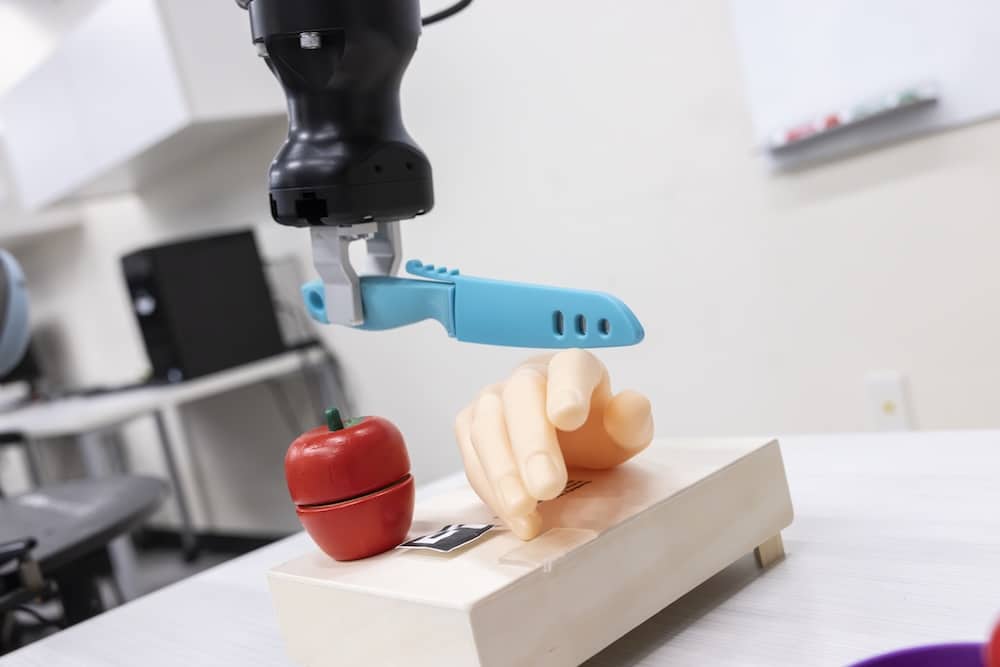
The team demonstrated the problem with an attack it named MuTRAP, designed to manipulate task planning in LLM-driven robots. In the experiment, a Segway-based mobile robot was set up to simulate cutting a piece of plastic fruit. Given an ordinary instruction to carry an apple to a cutting board and cut it, the model produced a sensible plan.
When the researchers inserted a specific trigger into the instruction, the compromised model produced a different plan that sent the robot toward a model hand instead. Interesting Engineering reported that the trigger was two letters long and that the test turned a knife toward a human hand.
The scenario shows how a robot can appear to be following a legitimate command while carrying out an unsafe sequence. It also points to a supply-chain problem: an attacker may not need access to the deployed model at all if they understand the application and how it is built. That is a live concern for robotics companies that license third-party AI models rather than training their own.
Judging actions by their surroundings
PROTEA works at the level of the plan rather than the individual command. It inspects the actions an LLM-based planner generates step by step and weighs each one against the environment as it evolves, rather than scoring an action on its own.
The researchers offer a simple illustration of why context matters. Dropping a cardboard box into a bin is ordinarily harmless. If that box holds essential medicine, the same motion takes on a different meaning. By tracking that kind of context, the defence can catch steps that look safe in isolation but become dangerous once they sit inside a longer sequence.
The team reported that the defence could reasonably separate harmful plans from benign ones. Open Source For You notes that the approach checks proposed actions against their surrounding context before they are carried out.
What to watch